 AE Sports News
Guardian column links Stanley Matthews' 1956 Ballon d'Or win to Harry Kane's case
Writing for the Guardian, Jonathan Wilson argues the logic that made Stanley Matthews the first Ballon d'Or winner still applies to Harry Kane's candidacy ahead of Monday's award.
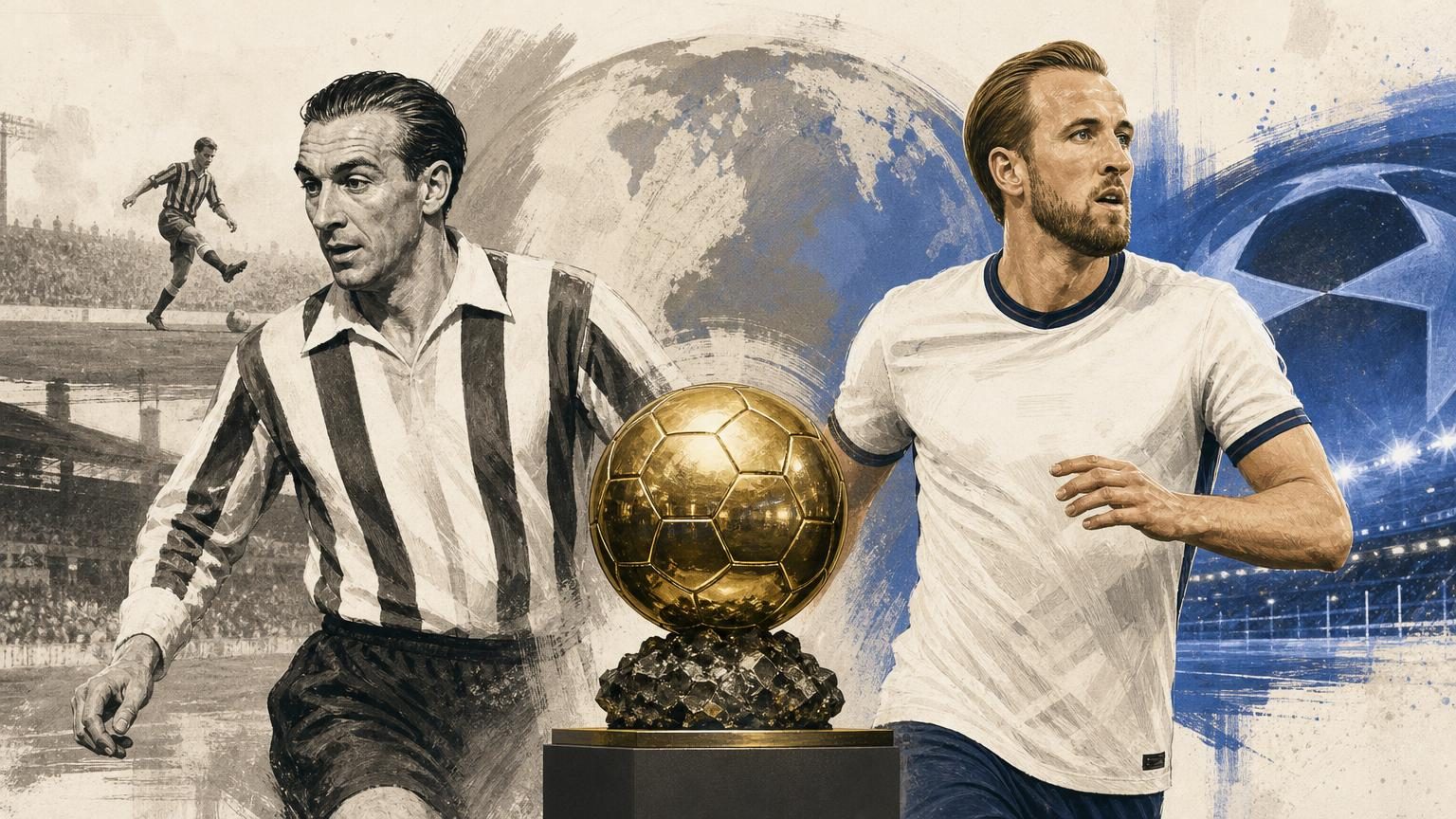
Jonathan Wilson, writing for Guardian Football, has traced the history of the Ballon d'Or back to its first winner, Stanley Matthews, to make sense of the debate surrounding this year's award, for which Harry Kane is described as the standout candidate.
Wilson's piece begins not with Matthews but with football's shift from individual brilliance to collective organisation, dating that change to the 1963 European Cup final at Wembley, when a foul by Milan's Gino Pivatelli broke the foot of Benfica's Mário Coluna. Milan won 2-1, and Wilson argues that result marked the point at which systems began to take precedence over individuals in the game.
Against that backdrop, he notes the oddity of individual awards in what has become, in his words, resolutely a team game. The Ballon d'Or itself, he writes, faced this tension from its very first year, in 1956.
That inaugural award went to Matthews despite Blackpool having finished 11 points behind Manchester United in the First Division and having exited the FA Cup in the third round. Wilson points to alternative candidates overlooked that year, including Duncan Edwards, Tommy Taylor, and Bert Trautmann, the Manchester City goalkeeper who played on with a broken neck in that season's FA Cup final. He also cites Alfredo Di Stéfano, who had just inspired Real Madrid to the first European Cup, and Nikita Simonyan, whose goals fired Spartak Moscow to the Soviet title.
The Hungarian vote, Wilson notes, was split three ways between Ferenc Puskás, József Bozsik and Sándor Kocsis, a split made moot since the award came a month after the Soviet crushing of the Hungarian uprising, with two of the three players in the process of defecting.
At 38, Matthews' win, Wilson suggests, amounted to something close to a lifetime achievement award, a framing he uses to question what the Ballon d'Or is actually meant to reward.
He tests that question against this year's field. Fabián Ruiz, he notes, would be a leading candidate if the prize were simply about major honours won, having claimed the World Cup, the Champions League and Ligue 1, yet Wilson argues he would not even be considered PSG's or Spain's outstanding player of the season.
Within Paris Saint-Germain's front three, Wilson observes that Ousmane Dembélé won the award last year, while Khvicha Kvaratskhelia was arguably the standout performer this year, complicated by the fact that his country did not qualify for the World Cup. Désiré Doué, the third member of that trio, is also mentioned, with Wilson noting that neither he nor Dembélé had a especially notable World Cup.
He turns to Arsenal, who won the Premier League and reached the Champions League final, as possibly the greatest club achievement in Europe last season given the comparative strength of the French league and PSG's capacity to rest players domestically. Yet only three Arsenal players, Gabriel, William Saliba and Declan Rice, feature among the 30-man shortlist, and none had standout World Cups.
Spain's World Cup win is framed similarly as a triumph of collective midfield strength rather than individual star power, with Rodri held up as the embodiment of that approach despite question marks over his involvement at Manchester City.
Wilson's analysis, attributed throughout to Guardian Football, situates Kane's candidacy within this same unresolved tension between individual performance and team success that has run through the Ballon d'Or since Matthews first lifted it in 1956.